
Mastering Python List Comprehensions: Powerful Patterns and Practical Use Cases
List comprehensions are one of Python’s most compelling features, enabling concise, readable, and efficient data transformations. These expressive constructs allow you to replace verbose for-loops with single-line expressions, which often improve both performance and clarity. In this article, we’ll explore Python list comprehensions in depth, moving from fundamentals to advanced idioms, and provide real-world code examples for each pattern.
1. Introduction to List Comprehensions
At its core, a list comprehension is a syntactic construct for building lists from iterables by applying an expression to each item.
# Basic usage: Square every number in a list
nums = [1, 2, 3, 4, 5]
squares = [x ** 2 for x in nums]
print(squares)  # Output: [1, 4, 9, 16, 25]
This single line replaces a multi-line for-loop, making it much more straightforward. List comprehensions have three main components: the input sequence, the output expression, and an optional filter condition.
2. Filtering Items With Conditions
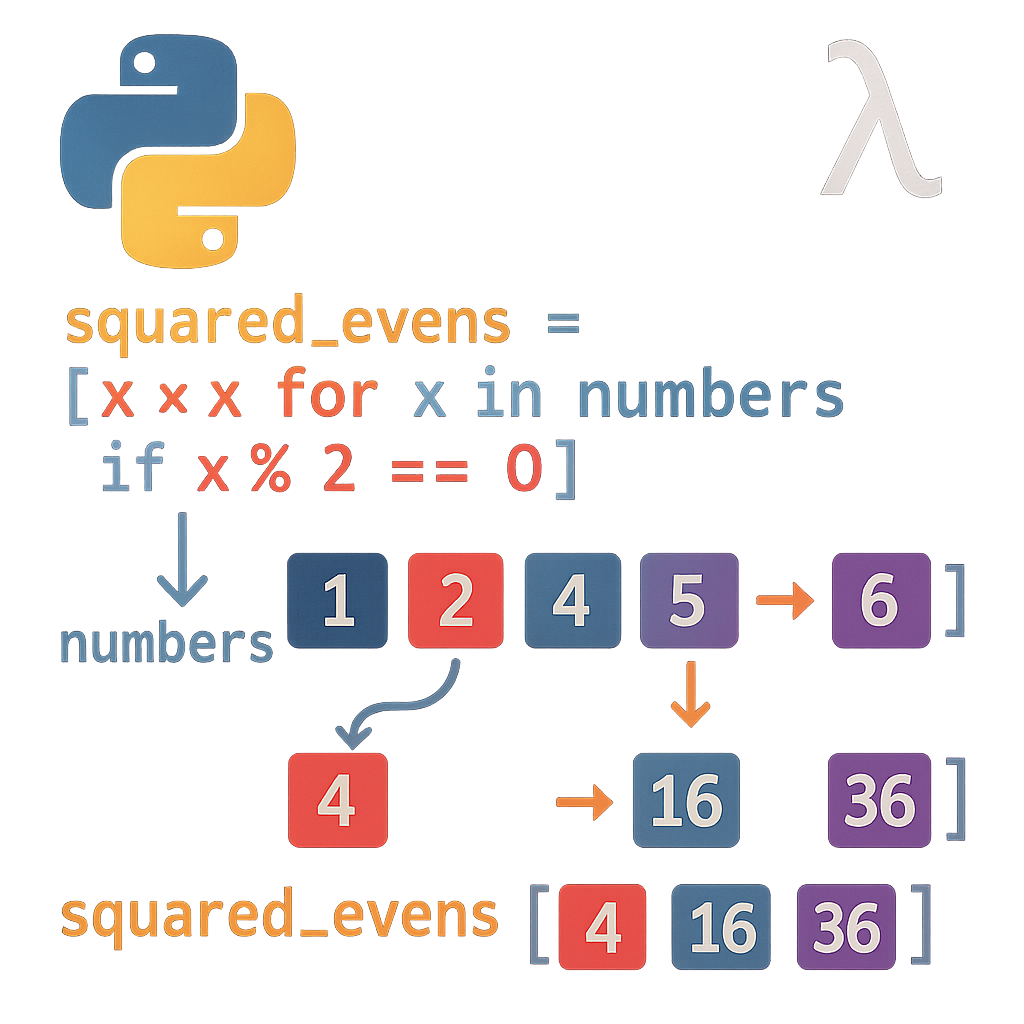
You can filter items by adding an if clause at the end. This is especially useful for extracting relevant data from a source.
# Filter only even numbers from the list
nums = [1, 2, 3, 4, 5, 6]
evens = [x for x in nums if x % 2 == 0]
print(evens)  # Output: [2, 4, 6]
This pattern increases efficiency compared to appending to a list within a loop, as the filtering happens inline. It also enhances readability for simple conditions.
3. Nested Loops and Flattening Structures
List comprehensions support multiple for-clauses, which is helpful when you need to flatten data structures or perform cross-product operations.
# Flatten a list of lists
matrix = [[1, 2], [3, 4], [5, 6]]
flattened = [item for row in matrix for item in row]
print(flattened)  # Output: [1, 2, 3, 4, 5, 6]

# Cartesian product: all pairs (i, j)
A = [1, 2]
B = ['a', 'b']
pairs = [(i, j) for i in A for j in B]
print(pairs)  # Output: [(1, 'a'), (1, 'b'), (2, 'a'), (2, 'b')]
This technique is powerful for flattening, combining, or filtering multi-dimensional data efficiently.
4. Dictionary and Set Comprehensions
Python comprehensions aren’t limited to lists—they can generate sets and dictionaries as well, following a similar pattern.
# Create a dictionary from two lists
keys = ['a', 'b', 'c']
values = [1, 2, 3]
dictionary = {k: v for k, v in zip(keys, values)}
print(dictionary)  # Output: {'a': 1, 'b': 2, 'c': 3}

# Generate a set of unique squares
nums = [1, 2, 2, 3, 4]
squares = {x ** 2 for x in nums}
print(squares)  # Output: {1, 4, 9, 16}
Use set and dictionary comprehensions when uniqueness or key-value mappings are required. This succinct approach avoids mutating objects in place and supports cleaner functional code patterns.
5. Real-World Applications and Performance Tips
Consider a practical scenario: extracting email addresses from log data that meet criteria.
# Filter valid email addresses from log lines
import re
log_lines = [
    'User: alice | Email: alice@example.com',
    'User: bob | Email: —',
    'User: charlie | Email: charlie99@domain.org'
]
pattern = re.compile(r'[\w\.-]+@[\w\.-]+')
emails = [match.group() for line in log_lines for match in [pattern.search(line)] if match]
print(emails)  # Output: ['alice@example.com', 'charlie99@domain.org']
Tips and Considerations:
- Avoid large, complex expressions inside comprehensions—they decrease readability and may impact performance.
- Use comprehensions primarily for transforming or filtering data, not for side effects.
- For extremely large datasets, consider using
generator expressions(parentheses instead of brackets) to save memory.
# Memory-efficient: generating squares lazily
squares_gen = (x ** 2 for x in range(10 ** 6))
List comprehensions significantly boost both clarity and speed for many data processing tasks. Mastering them will let you write faster, cleaner, and more Pythonic code.
Useful links: