
Understanding and Optimizing Bubble Sort in Python: A Deep Dive
Introduction to Bubble Sort
Bubble sort stands as one of the simplest sorting algorithms, often used to introduce sorting concepts to beginners. While its performance can’t match more advanced methods in practice, its value lies in teaching algorithmic thinking, comparison operations, and optimization strategies. In this article, we will thoroughly explore Bubble Sort in Python, analyze its inner workings, provide step-by-step implementations, discuss real-world applicability, and offer tips for optimization.
Section 1: Fundamental Logic of Bubble Sort
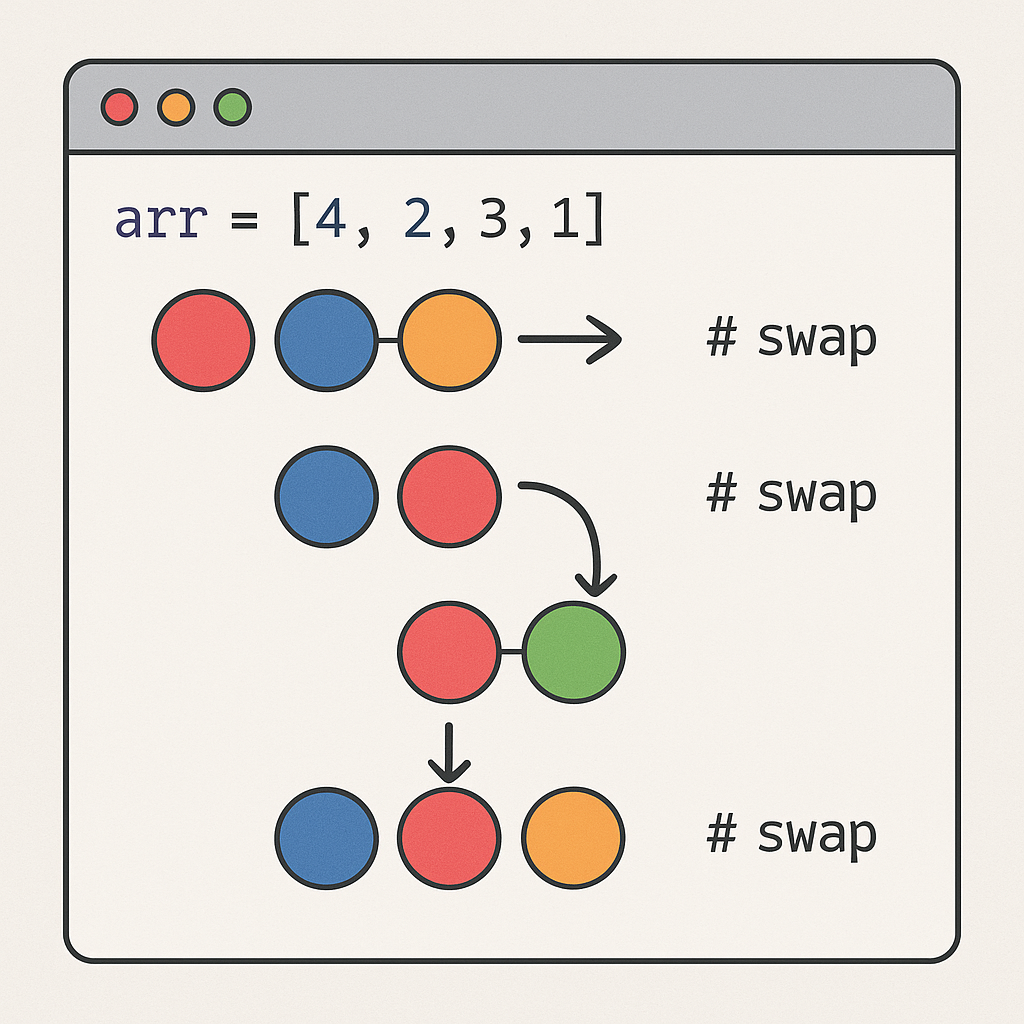
At its heart, Bubble Sort iteratively compares and swaps adjacent items in a list until the entire sequence is sorted. Its name comes from the way smaller elements “bubble” to the top (beginning) of the array, while larger elements sink to the bottom (end).
def bubble_sort(arr):
    n = len(arr)
    for i in range(n):
        for j in range(0, n-i-1):
            if arr[j] > arr[j+1]:
                arr[j], arr[j+1] = arr[j+1], arr[j]
    return arr

# Example
nums = [64, 34, 25, 12, 22, 11, 90]
print(bubble_sort(nums))  # Output: [11, 12, 22, 25, 34, 64, 90]
This implementation makes n passes over the list, comparing pairs and swapping when needed. Each iteration efficiently places the next-largest value in its final location.
Section 2: Analyzing Bubble Sort’s Efficiency
Despite its simplicity, Bubble Sort’s time complexity is O(n2) in the average and worst cases, making it inefficient for large datasets. However, it’s useful for nearly sorted datasets, classrooms, or constraints where intermediate comparisons must be visible.
# Demonstrating Bubble Sort with a Step Counter
def bubble_sort_steps(arr):
    n = len(arr)
    total_swaps = 0
    for i in range(n):
        for j in range(0, n-i-1):
            if arr[j] > arr[j+1]:
                arr[j], arr[j+1] = arr[j+1], arr[j]
                total_swaps += 1
    print(f"Total swaps: {total_swaps}")
    return arr

bubble_sort_steps([5, 1, 4, 2, 8])
# Output: [1, 2, 4, 5, 8] and Total swaps: 4
Visibility into internal steps is a key virtue if you want to demonstrate how sorting algorithms work interactively in educational contexts.
Section 3: Optimizing Bubble Sort
Bubble Sort can be made significantly faster with early termination if a pass completes without any swaps—signaling that the list is already sorted. Here’s how you can implement this optimization:
def bubble_sort_optimized(arr):
    n = len(arr)
    for i in range(n):
        swapped = False
        for j in range(0, n-i-1):
            if arr[j] > arr[j+1]:
                arr[j], arr[j+1] = arr[j+1], arr[j]
                swapped = True
        if not swapped:
            break
    return arr

# Almost sorted input
nums = [1, 2, 3, 4, 5, 0]
print(bubble_sort_optimized(nums))  # [0, 1, 2, 3, 4, 5]
Early exits greatly improve performance on nearly or already sorted data, which is common in some real-world scenarios, such as UI lists after minor edits.
Section 4: Practical Use Cases and Automating Bubble Sort in Workflows
While rarely used in production for large or critical data, Bubble Sort can be an excellent choice when:
- Datasets are tiny (a few dozen elements)
- The code must be extremely simple and readable
- Visualization or step-by-step user demonstrations are needed
- You’re implementing sorting within highly constrained or embedded environments
Here’s how to automate sorting a list fetched from an API:
import requests

def fetch_and_sort(url):
    response = requests.get(url)
    data = response.json()['numbers']
    return bubble_sort(data)

# Suppose API returns: { "numbers": [88, 12, 42, 61, 7] }
# print(fetch_and_sort('https://api.example.com/numbers'))
This approach demonstrates how to integrate simple sorting directly with data fetching workflows, suitable for quick scripts or classroom exercises.
Section 5: Performance Benchmarks and Alternatives
Let’s benchmark Bubble Sort against Python’s built-in efficient sort():
import time
arr = [i for i in range(1000, 0, -1)]

start = time.time()
bubble_sort(arr.copy())
print(f"Bubble sort: {time.time() - start:.4f} seconds")

start = time.time()
sorted(arr)
print(f"Built-in sort: {time.time() - start:.4f} seconds")
Tip: Python’s built-in sorting algorithm is Timsort (O(n log n)), optimized for real-world data. While Bubble Sort is useful as a teaching or debugging tool, always prefer built-in or optimized sorting in production unless you have a compelling reason not to.
Conclusion
Bubble Sort’s elegant simplicity has made it a mainstay in learning material and small-data applications, despite its performance limitations. By understanding both its basic logic and subtle optimizations, you’ll strengthen your algorithmic intuition—and know when it’s the right fit (and when it isn’t). For production, always benchmark your choice and prefer built-in or faster alternatives for large-scale data.
Useful links: