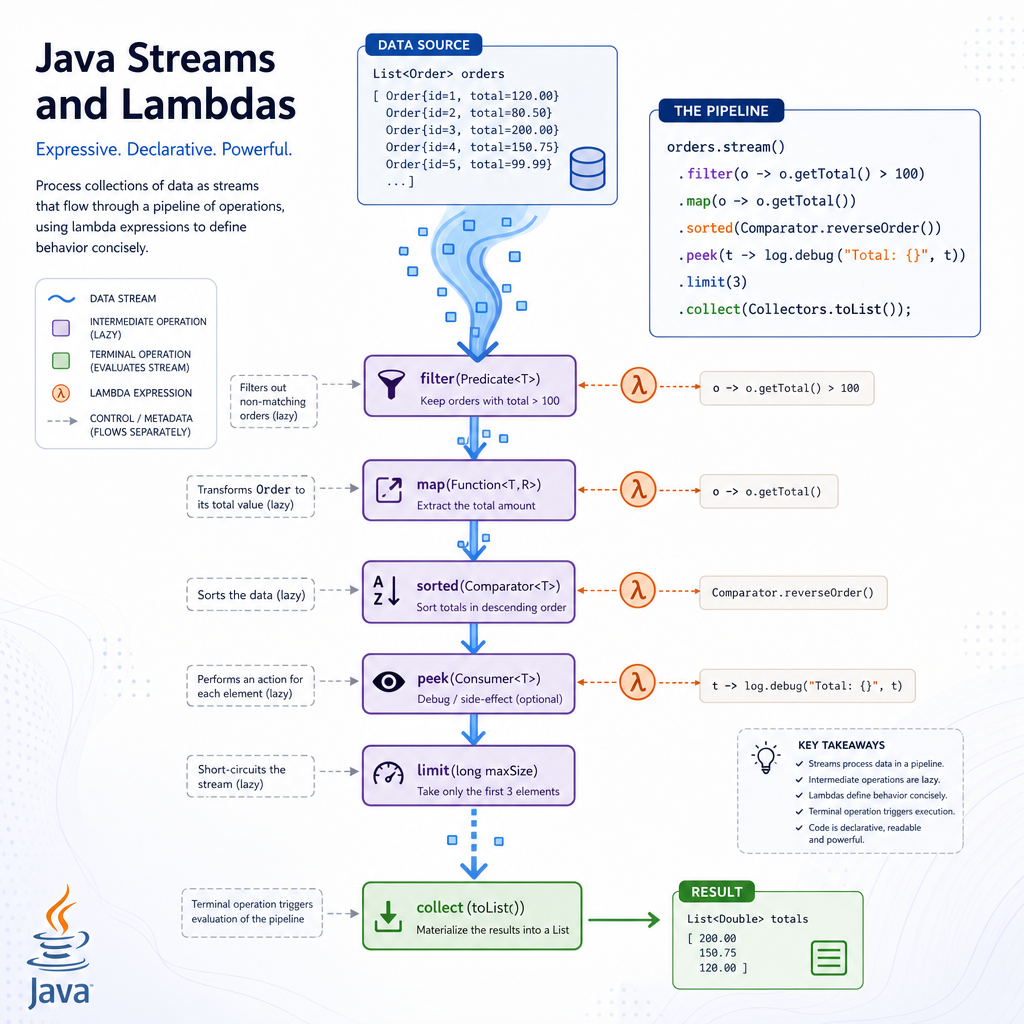

Functional Interfaces Unlocked: Real-world Applications with Java 8 Streams
Java 8 revolutionized the way we think about and write Java code by introducing features aimed at making the language more expressive and concise. Among these features, functional interfaces and the Streams API stand out as powerful tools for processing collections concisely using lambda expressions. In this article, we’ll explore how to harness these elements by refactoring cumbersome code into sleek, maintainable solutions.
Understanding Functional Interfaces
Functional interfaces are an interface with a single abstract method. This characteristic enables them to serve as the target for lambda expressions and method references. The most prominent functional interfaces include Predicate, Function, Supplier, and Consumer from the java.util.function package.
Here’s a simple example using the Predicate interface:
Predicate<String> isLongString = s -> s.length() > 10;In this lambda expression, we provide an implementation for the test method of the Predicate interface to check if a string’s length is greater than 10.
Leveraging the Streams API
The Streams API allows processing elements of a collection in a functional style. By applying streams, we can rewrite loops and conditionals into a series of transformations and actions, significantly boosting code readability and efficiency.
Imagine having a list of strings from which you want to filter out the short ones and collect the results in uppercase:
List<String> strings = Arrays.asList("hello", "world", "java", "streams", "interface");
List<String> longUppercaseStrings = strings.stream()
  .filter(s -> s.length() > 5)
  .map(String::toUpperCase)
  .collect(Collectors.toList());
This snippet filters strings longer than five characters and converts them to uppercase using the stream operations: filter, map, and collect.
Refactoring Collection-Processing Logic
Let’s refactor a classic collection-processing loop into a stream-based equivalent. Suppose we’re tasked with doubling all the integers in a list that are greater than five.
First, here’s a typical approach using loops:
List<Integer> numbers = Arrays.asList(1, 6, 3, 7, 4, 8);
List<Integer> results = new ArrayList<>();
for (Integer number : numbers) {
  if (number > 5) {
    results.add(number * 2);
  }
}
We can refactor it using streams and functional interfaces:
List<Integer> results = numbers.stream()
  .filter(n -> n > 5)
  .map(n -> n * 2)
  .collect(Collectors.toList());
This approach minimizes boilerplate code and focuses on what to do rather than how to do it.
Performance Considerations and Best Practices
While streams offer elegance and clarity, they also involve certain trade-offs. For instance, the initial overhead of stream operations can outweigh the benefits for small collections. Always prefer orderly data transformations over expensive operations inside lambda expressions, and consider parallel streams when working with large datasets.
List<Integer> parallelResults = numbers.parallelStream()
  .filter(n -> n > 5)
  .map(n -> n * 2)
  .collect(Collectors.toList());
Parallel streams process collections in a multi-threaded manner, potentially offering performance gains if your environment supports it.
Conclusion
Java 8’s functional interfaces and the Streams API collectively open a new frontier for writing clear, concise, and maintainable code. By transitioning to a more declarative style, we can alleviate verbose loops and conditionals, making room for elegance and efficiency in Java applications.
Continue exploring these features, and discover how they can transform your everyday coding tasks into seamless and expressive operations.
Useful links: