
Algorithm Deep Dive: Solving Knapsack Problem in JavaScript
The Knapsack problem is a classic algorithmic problem that poses a challenge in combinatorial optimization: given a set of items, each with a weight and a value, determine the number of each item to include in a collection so that the total weight is less than or equal to a given limit and the total value is as large as possible. In this article, we’ll unpack the dynamic programming approach to solving this problem using JavaScript, complete with comprehensive code breakdowns.
1. Understanding the Problem
Before diving into code, it’s crucial to grasp the problem’s requirements and constraints. The Knapsack problem has two versions: the 0/1 Knapsack, where each item can either be taken or not, and the Fractional Knapsack, where items can be divided. We will focus on the 0/1 Knapsack problem. Assume we have a knapsack that can carry a maximum weight of W and a set of items, each with a weight and value. Our goal is to maximize the value of the items in the knapsack without exceeding the weight limit.
2. Dynamic Programming Approach
Dynamic programming is ideal for this problem because it breaks the problem down into simpler subproblems. Let’s build a solution step-by-step.
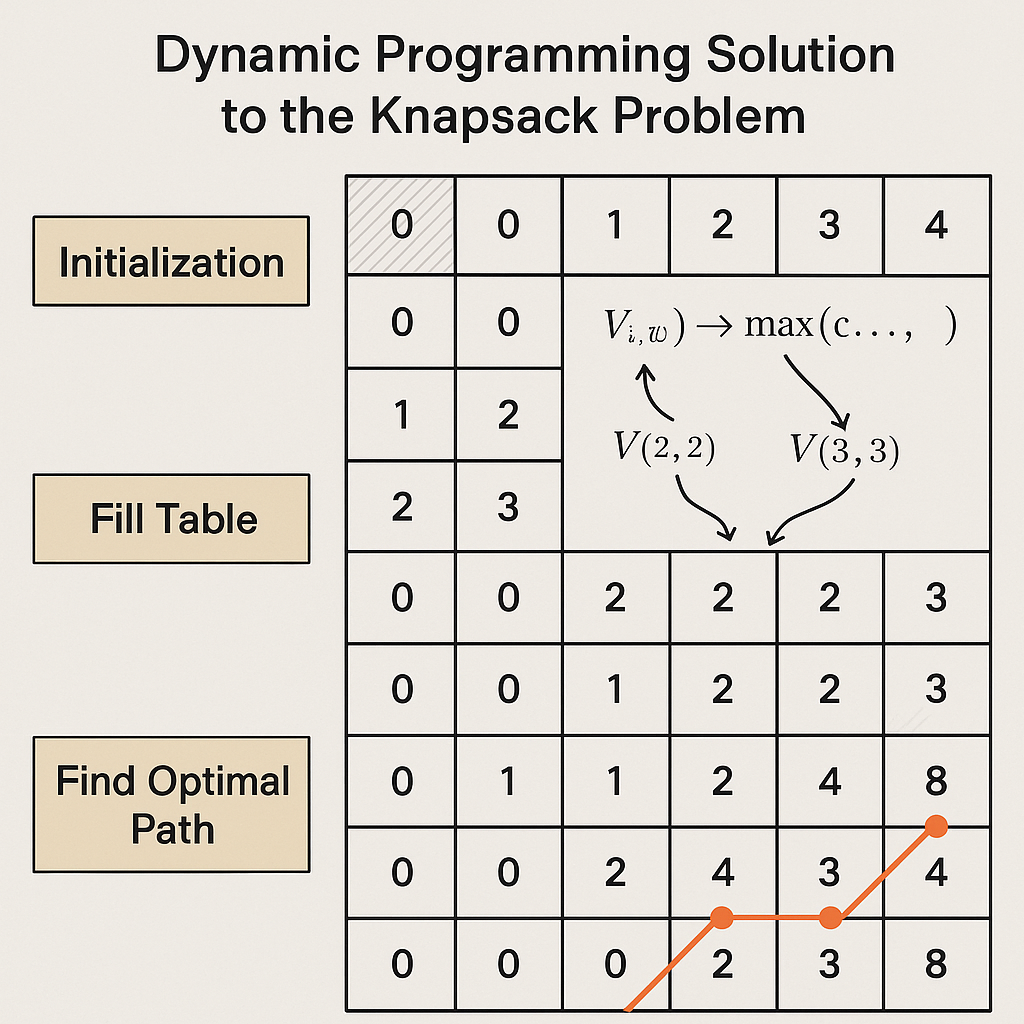
We’ll use a table to store the maximum possible value obtainable with available items and weight constraints. Each cell dp[i][w] in our table represents the maximum value that can be attained with the first i items and weight capacity w.
Let’s initialize our table and then iterate over all items and weights to fill in the table:
function knapsack(values, weights, W) {
  const n = values.length;
  const dp = Array.from({ length: n + 1 }, () => Array(W + 1).fill(0));
This code initializes a table dp with dimensions (n+1) x (W+1), filled with zeros. Here, n is the number of items, and W is the maximum weight of the knapsack.
3. Filling the DP Table
We fill the table using the recurrence relation. For each item i and weight capacity w, decide whether to include item i or exclude it:
for (let i = 1; i <= n; i++) {
  for (let w = 0; w <= W; w++) {
    if (weights[i - 1] <= w) {
      dp[i][w] = Math.max(dp[i - 1][w], dp[i - 1][w - weights[i - 1]] + values[i - 1]);
    } else {
      dp[i][w] = dp[i - 1][w];
    }
  }
}
Here, if the weight of the item is less than the current capacity, the item can be included. Thus, we take the maximum of two options: not taking the item or taking the item and adding its value.
4. Extracting the Solution
After constructing the table, retrieving the result is straightforward. The maximum value that can be carried is in `dp[n][W]`.
const maxValue = dp[n][W];
console.log('Maximum value in Knapsack:', maxValue);
We can further track back to see which items make up this optimal solution by backtracking from `dp[n][W]`.
let w = W;
let selectedItems = [];
for (let i = n; i > 0 && w > 0; i--) {
  if (dp[i][w] !== dp[i - 1][w]) {
    selectedItems.push(i - 1);
    w -= weights[i - 1];
  }
}
console.log('Selected items:', selectedItems);
This walks back through the DP table and collects the indices of selected items.
5. Performance Considerations and Optimization
The time complexity of this algorithm is O(n*W), which is efficient compared to the exponential complexity of a naive recursive solution. However, for large capacities or item sets, performance could still be an issue. Trade-offs between space and time complexity can be crucial – using a 2D array demands considerable memory. We can reduce space complexity by optimizing to use a single row during computation.
By iterating backwards, avoiding overwriting data, the 2D table can be reduced to a 1D array:
const dp = Array(W + 1).fill(0);
for (let i = 1; i <= n; i++) {
  for (let w = W; w >= weights[i - 1]; w--) {
    dp[w] = Math.max(dp[w], dp[w - weights[i - 1]] + values[i - 1]);
  }
}
This approach maintains the time complexity while saving on space, which is beneficial for large inputs.
Overall, understanding and applying dynamic programming to the Knapsack problem demonstrates its power in tackling complex optimization challenges. By systematically building up layers of solutions, we achieve the desired outcome with efficient use of resources.
Useful links: