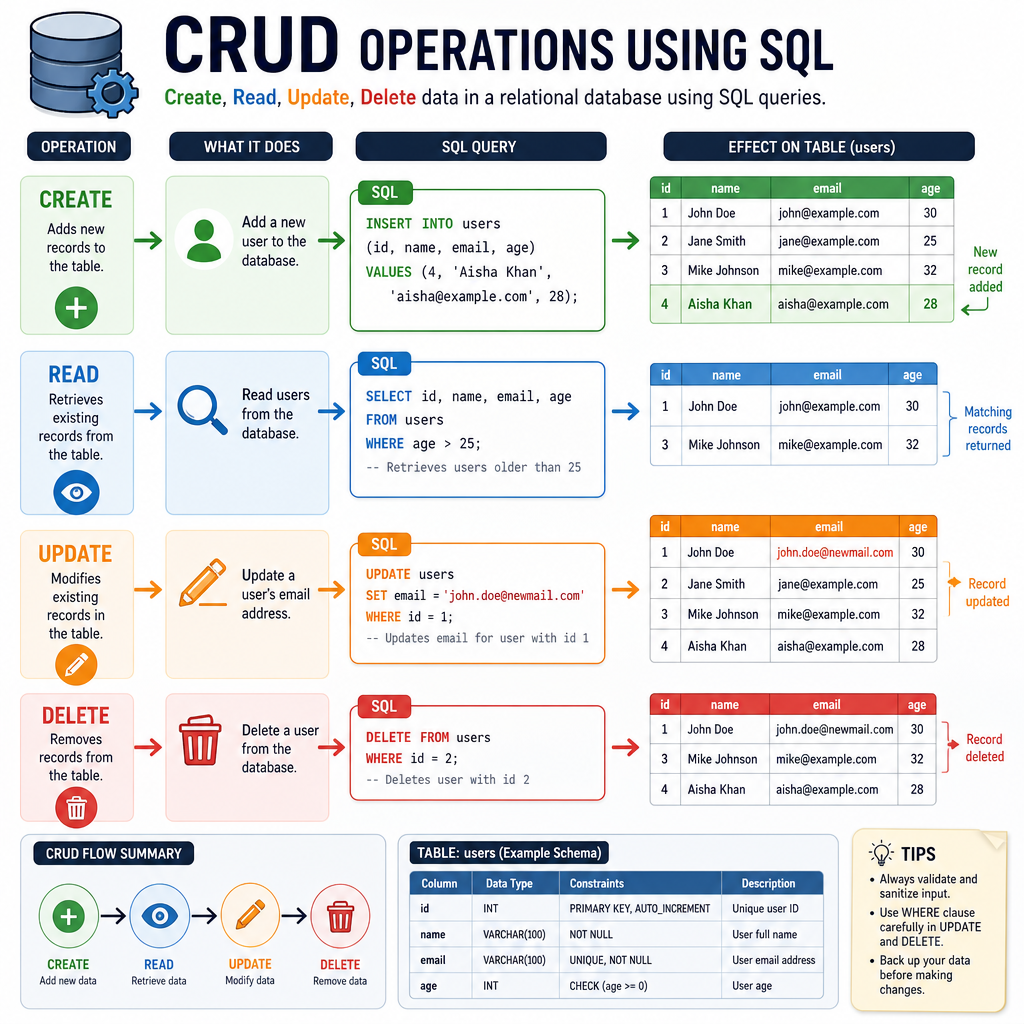

“CRUD” Operations Explained Through SQL Queries
When managing data in a relational database, CRUD operations—Create, Read, Update, and Delete—are fundamental. These operations allow you to orchestrate data flow and maintain database integrity. In this blog post, we’ll explore each CRUD operation with SQL queries that you can execute on simple datasets. By the end, you’ll be equipped with essential knowledge to manipulate data in your applications effectively.
1. Creating Data with SQL: The INSERT Statement
The ‘Create’ part of CRUD pertains to inserting new data into your database. The SQL INSERT statement allows you to add rows to a table. Let’s assume we have a table called employees and need to add new records:
INSERT INTO employees (first_name, last_name, email) VALUES ('John', 'Doe', 'john.doe@example.com');
This snippet inserts a new row into the employees table. You specify the column names followed by the corresponding values. Using INSERT is straightforward, but efficiency can be improved when inserting multiple rows:
INSERT INTO employees (first_name, last_name, email) VALUES

('Jane', 'Smith', 'jane.smith@example.com'),

('Robert', 'Brown', 'robert.brown@example.com');
Inserting multiple rows in one statement reduces the need for repeated interactions with the database, thus improving performance.
2. Reading Data: The SELECT Statement
Reading data is essential for displaying or processing information from your database. SQL’s SELECT statement enables you to query specific data:
SELECT first_name, last_name FROM employees WHERE department_id = 5;
This query retrieves employee names who belong to a particular department. WHERE clauses are powerful tools for filtering and retrieving data that meets certain criteria, which optimizes the precision of data fetching.
To get unique values, consider using SELECT DISTINCT: SELECT DISTINCT department_id FROM employees; This ensures no duplicate departments are returned.
3. Updating Data: The UPDATE Statement
Updating existing records involves changing data fields without altering their unique identifiers. SQL UPDATE allows modifications:
UPDATE employees SET email = 'john.d@gmail.com' WHERE first_name = 'John' AND last_name = 'Doe';
This query modifies John’s email address. Note the importance of the WHERE clause for targeting the specific record; omitting it will update all records.
Optimizing updates is key: batch updates reduce transactions, and conditional logic within UPDATE statements increases flexibility.
4. Deleting Data: The DELETE Statement
Deleting data is sometimes necessary to remove outdated or incorrect entries. The DELETE statement is utilized for this purpose:
DELETE FROM employees WHERE email = 'unknown@example.com';
This statement eliminates records with the specified email. As with updates, not specifying WHERE can lead to data loss. Therefore, always ensure your conditions are set accurately to avoid deleting unintended records.
An important optimization is using database policies or constraints to restrict deletions and ensure integrity.
5. CRUD Operations in Real Projects
In real-world applications, CRUD operations form the backbone of data manipulation layers. For example, a web application might use CRUD operations to manage user accounts. A robust understanding of SQL CRUD operations not only optimizes database interactions but also ensures that applications built upon these interactions are efficient, scalable, and secure.
Working with ORMs (Object-Relational Mappers) in languages like Python’s SQLAlchemy or Java’s Hibernate can abstract CRUD operations while allowing control over raw SQL for complex queries when needed. This flexibility empowers developers to blend the simplicity of ORM with the power of SQL when required.
By mastering CRUD operations, you equip yourself with the foundational skills needed to manage and manipulate data within any relational database, paving the way for more advanced database programming and analysis.
Useful links: