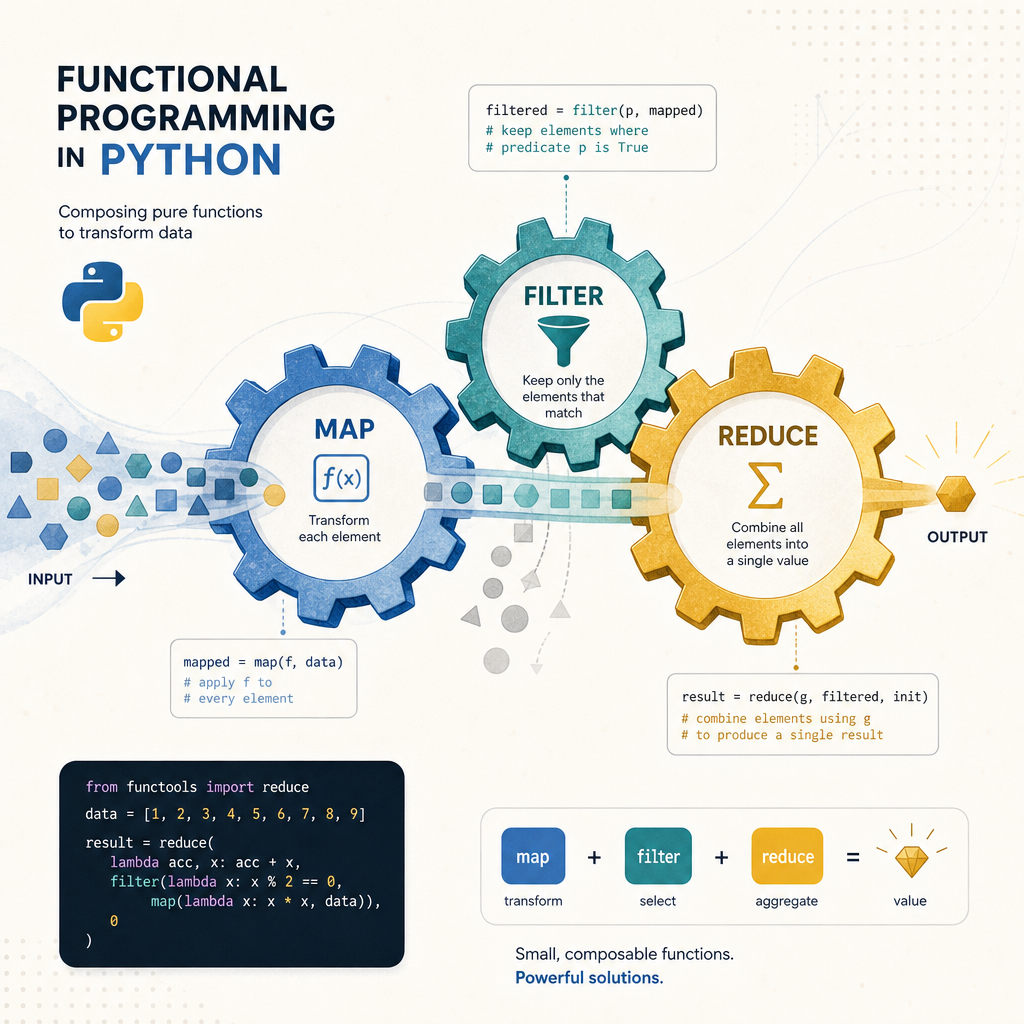

Map, Reduce, Filter: Essential Functional Programming Tools in Python
Functional programming in Python is a programming paradigm that allows you to create more modular and reusable code. Three essential tools of functional programming are map, reduce, and filter. These functions are widely used to process data collections in a clean and efficient manner. This article will break down each function, show how to use them effectively, and explain why they are critical tools in a Python developer’s toolkit.
Understanding Map
The map function applies a given function to all items in an input list. It returns a map object (an iterator) of the results.
def square(x):
    return x * x

nums = [1, 2, 3, 4, 5]
squared = map(square, nums)

print(list(squared))  # Output: [1, 4, 9, 16, 25]
Here, map takes the square function and applies it to each element of the nums list. This is a cleaner and more performant alternative to looping through the list and applying the function manually.
Leveraging Reduce
The reduce function is used to apply a rolling computation to sequential pairs of values in a list. It’s part of the functools module and needs to be imported before use.
from functools import reduce

def add(x, y):
    return x + y

nums = [1, 2, 3, 4, 5]
sum_of_nums = reduce(add, nums)

print(sum_of_nums)  # Output: 15
In this example, reduce applies the add function cumulatively to the items of the list, from left to right. It sums up the numbers efficiently without the need for an explicit loop outside the function.
Filtering with Filter
The filter function constructs an iterator from elements of an iterable that satisfy a function’s condition.
def is_even(x):
    return x % 2 == 0

nums = [1, 2, 3, 4, 5, 6]
even_nums = filter(is_even, nums)

print(list(even_nums))  # Output: [2, 4, 6]
The filter function leaves us with only the numbers that satisfy the is_even condition, streamlining the process of filtering out items manually.
Combining Map, Filter, and Reduce
These tools are often used in combination to perform complex data operations succinctly.
from functools import reduce

nums = [1, 2, 3, 4, 5, 6, 7, 8, 9]
even_squares = map(lambda x: x * x, filter(lambda x: x % 2 == 0, nums))

total_sum = reduce((lambda x, y: x + y), even_squares)

print(total_sum)  # Output: 120
By piping filter and map, we first filter out even numbers and then square them. The reduce function sums up the squared values. This illustrates the power and elegance of functional programming to handle complex data transformations efficiently.
Performance Considerations
When using map, filter, or reduce, it’s crucial to consider the performance implications, especially with large datasets. The functional approach avoids the need for auxiliary lists and can often lead to cleaner and potentially faster code. However, remember to continuously optimize based on the specific use case, particularly regarding readability and performance balance.
By understanding and employing these functional utilities appropriately, you can write more concise and expressive Python code that is both easier to maintain and enhance.
Useful links: