
Mastering Python Generators: Efficient Iteration and Lazy Evaluation in Action
Introduction
Generators are one of Python’s most powerful features, allowing developers to write efficient, memory-friendly code for iterating over large or complex data sets. Instead of constructing full lists in memory, generators yield items one at a time—making processing enormous files, streams, or infinite sequences possible with minimal memory usage. This post will break down how generators work, where to use them, and clever patterns to optimize your Python codebase.
1. The Fundamentals: What Are Generators and Why Use Them?
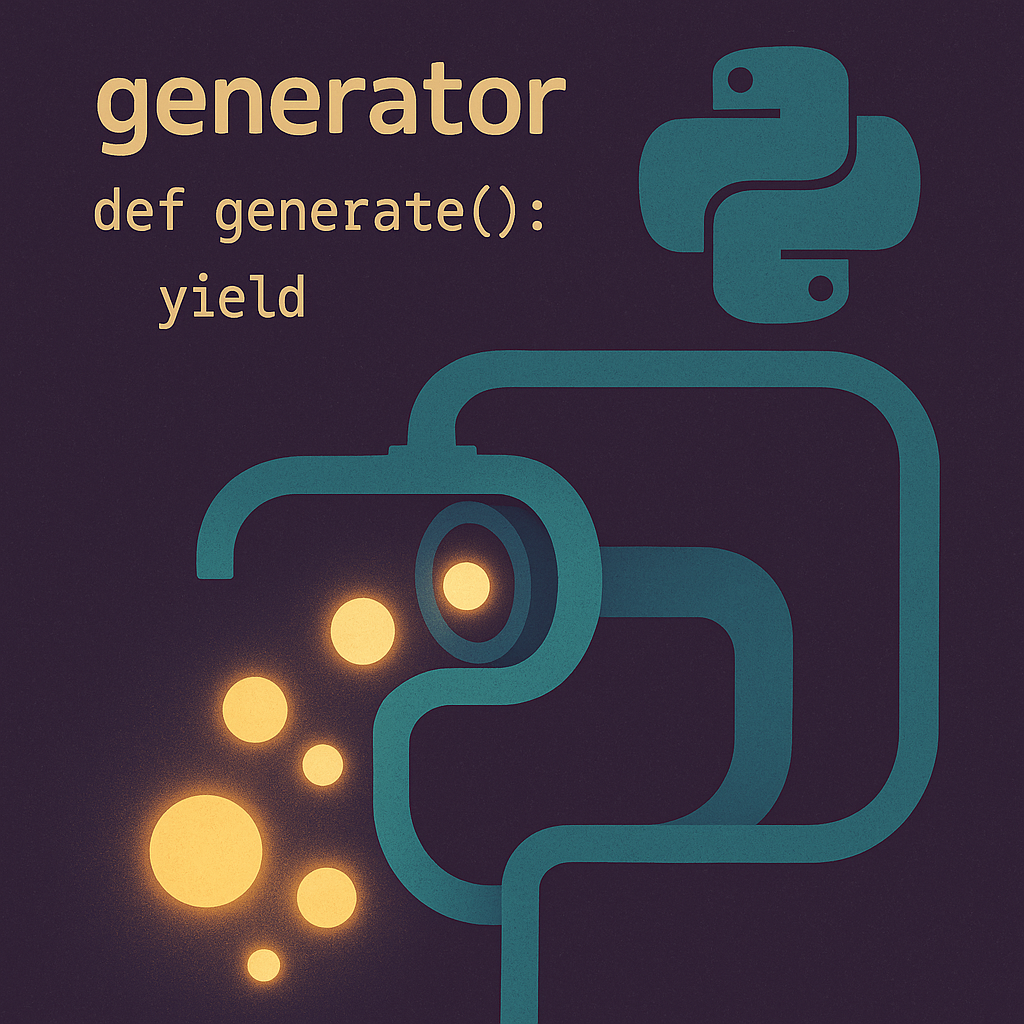
Generators are functions that yield values lazily—producing results on demand. This is achieved using the yield keyword instead of return. The primary advantage: they conserve memory, especially when dealing with vast or potentially unbounded datasets.
Example: Generating Squares Lazily
def generate_squares(n):
    for num in range(n):
        yield num ** 2

for square in generate_squares(5):
    print(square)
Output:
0
1
4
9
16
Why It Works: Each call to yield pauses the function, allowing it to resume and produce the next value only when needed—saving memory and computing resources versus creating a whole list.
2. Generator Expressions: Concise, Efficient Syntax
You can create generators with generator expressions (similar to list comprehensions but with parentheses). This is extremely handy for pipeline-style data processing.
Example: Filtering Large Files
filename = 'large_log.txt'
errors = (line for line in open(filename) if 'ERROR' in line)

for error in errors:
    print(error.strip())
Why It Works: Even with gigabytes of log data, only one line is loaded at a time—enabling efficient search and filtering with minimal memory usage.
3. Real-World Automation: Processing Streams and Infinite Data
Generators shine when processing data that doesn’t fit in memory, like real-time sensor feeds or infinite mathematical sequences.
Example: Simulating a Sensor Data Stream
import random
import time

def stream_sensor_data():
    while True:
        yield random.uniform(20.0, 25.0)
        time.sleep(1)

sensor = stream_sensor_data()
for i in range(5):
    print(next(sensor))
Output (sample):
22.537425
21.091202
…
4. Chaining Generators: Powerful Data Pipelines
By composing generators, you can construct powerful pipelines for data transformation and filtering.
Example: Chained Filtering and Mapping
def even_numbers(iterable):
    for x in iterable:
        if x % 2 == 0:
            yield x

def squares(iterable):
    for x in iterable:
        yield x ** 2

nums = range(10)
pipeline = squares(even_numbers(nums))
print(list(pipeline))  # Output: [0, 4, 16, 36, 64]
Optimization Tip: Chaining avoids intermediate storage, maximizing performance on large data sets.
5. Performance, Pitfalls, and Advanced Patterns
Generators can dramatically improve performance, but beware: once exhausted, a generator cannot be reset or reused. For debugging or when you need to access results repeatedly, convert to a list explicitly if memory allows (results = list(generator)).
Advanced: Delegating with yield from
If you need to compose complex generator flows, use yield from for clean delegation.
def numbers():
    yield from range(3)
def more_numbers():
    yield from numbers()
    yield 10

for x in more_numbers():
    print(x)
# Output: 0 1 2 10
Conclusion
Python generators open up a new world of memory-efficient, expressive code. By integrating them into your data processing, automation, and pipeline scripts, you future-proof your applications against scaling challenges and inefficiencies. Experiment with the patterns above and watch your Python code become both faster and more elegant!
Useful links: