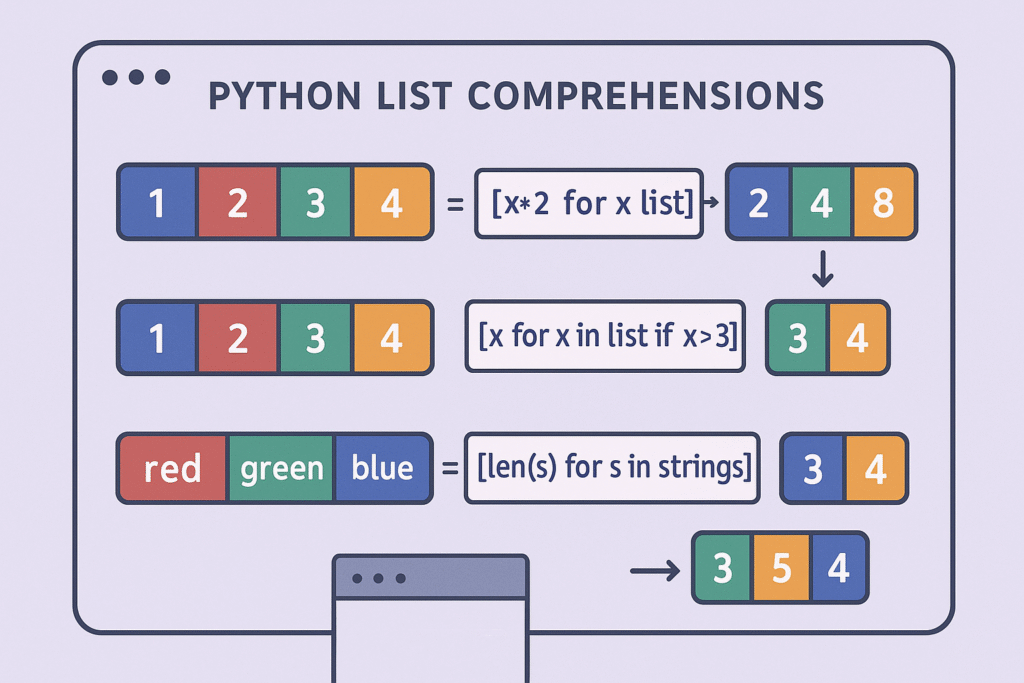

Mastering Python’s list comprehensions: Powerful Patterns and Advanced Techniques
Introduction
Python’s list comprehensions are celebrated for their elegance and efficiency when transforming, filtering, and constructing lists. But beyond basic use, list comprehensions offer advanced patterns that unlock expressive, readable, and high-performance code. This article will guide you through the fundamentals, practical applications, and advanced tricks, culminating in tips for writing optimal, Pythonic code.
1. The Basics: From Loops to List Comprehensions
List comprehensions provide a compact sytnax for mapping or filtering elements. Compare a classic loop:
# Traditional loop approach
squares = []
for x in range(10):
    squares.append(x ** 2)
print(squares)  # [0, 1, 4, 9, ... 81]
The equivalent list comprehension:
# List comprehension
squares = [x ** 2 for x in range(10)]
print(squares)
Why use list comprehensions? They reduce boilerplate, clarify intent, and often execute faster than explicit loops since they’re optimized at the C level in CPython. Consider them for transformations or filtering where a new list is built from an iterable.
2. Adding Conditions: Filtering Data On the Fly
List comprehensions excel at filtering data inline. For example, extracting even numbers from a list:
# Filter for even numbers
evens = [x for x in range(20) if x % 2 == 0]
print(evens)  # [0, 2, 4, ... 18]
You can also apply transformations only to filtered results:
# Uppercase words starting with 'a'
words = ['apple', 'banana', 'avocado']
resolved = [w.upper() for w in words if w.startswith('a')]
print(resolved)  # ['APPLE', 'AVOCADO']
Performance Tip: Place the if clause outside the main expression if you want to filter before transforming — it avoids unnecessary computation.
3. Nested List Comprehensions: Flattening and Cartesian Products
Nested comprehensions allow you to iterate through multiple sequences. Consider flattening a matrix:
# Flatten a 2D list
matrix = [[1, 2, 3], [4, 5], [6]]
flat = [element for sublist in matrix for element in sublist]
print(flat)  # [1, 2, 3, 4, 5, 6]
For generating Cartesian products:
# Cartesian product (all (x, y) pairs)
x_items = [1, 2, 3]
y_items = ['a', 'b']
pairs = [(x, y) for x in x_items for y in y_items]
print(pairs)  # [(1, 'a'), (1, 'b'), ..., (3, 'b')]
Why is this powerful? It enables concise, readable code for data manipulation, matrix operations, and permutation problems.
4. Dictionary and Set Comprehensions: Beyond Lists
The comprehension syntax extends naturally to other containers. For dictionaries:
# Dictionary comprehension: mapping words to their lengths
words = ['apple', 'banana', 'cherry']
length_map = {word: len(word) for word in words}
print(length_map)  # {'apple': 5, 'banana': 6, 'cherry': 6}
Set comprehensions help deduplicate while transforming:
# Set comprehension: unique squared numbers
nums = [1, 2, 2, 3]
squared_unique = {x ** 2 for x in nums}
print(squared_unique)  # {1, 4, 9}
Pro Tip: Use dictionary and set comprehensions to optimize tasks involving mapping, unique collections, or lookups over transformations.
5. Advanced and Real-World Uses: Conditionals, Functions, and Performance
For more dynamic cases, you can include if...else within the expression (not just the filter):
# Replace negative numbers with zero
data = [3, -2, 5, -1]
normalized = [x if x > 0 else 0 for x in data]
print(normalized)  # [3, 0, 5, 0]
You can also call functions inline:
# Apply string.strip to a list of strings
raw_lines = [' a ', 'b ', ' c']
stripped = [line.strip() for line in raw_lines]
print(stripped)  # ['a', 'b', 'c']
For large datasets, consider generator expressions (using (...) instead of [...]) to save memory by yielding items one at a time:
# Generator expression for large files
with open('bigfile.txt') as f:
    non_empty = (line for line in f if line.strip())
    for line in non_empty:
        process(line)
Optimization Note: Use list comprehensions for small-to-medium lists, but switch to generators for big data workloads to avoid memory exhaustion.
Conclusion
Python’s list comprehensions, along with set and dictionary variants, empower developers to write expressive and efficient code for transforming, filtering, and aggregating data. Knowing when and how to leverage comprehensions can significantly boost productivity and readability in real-world automation and data processing tasks. Experiment with nesting, conditional logic, and integrating functions to make your Pythonic toolkit more powerful and performant!
Useful links: