
Mastering Merge Sort: A Deep Dive into Efficient Sorting in Python
Introduction
Sorting is a fundamental operation in computer science and software development. Among the various sorting algorithms, Merge Sort stands out for its efficiency, stability, and use of the divide and conquer paradigm. In this article, we’ll explore Merge Sort in Python, covering the theory, implementation, real-world use cases, optimizations, and performance considerations. If you need an efficient way to sort large datasets, understanding Merge Sort is invaluable.
1. Understanding the Merge Sort Algorithm
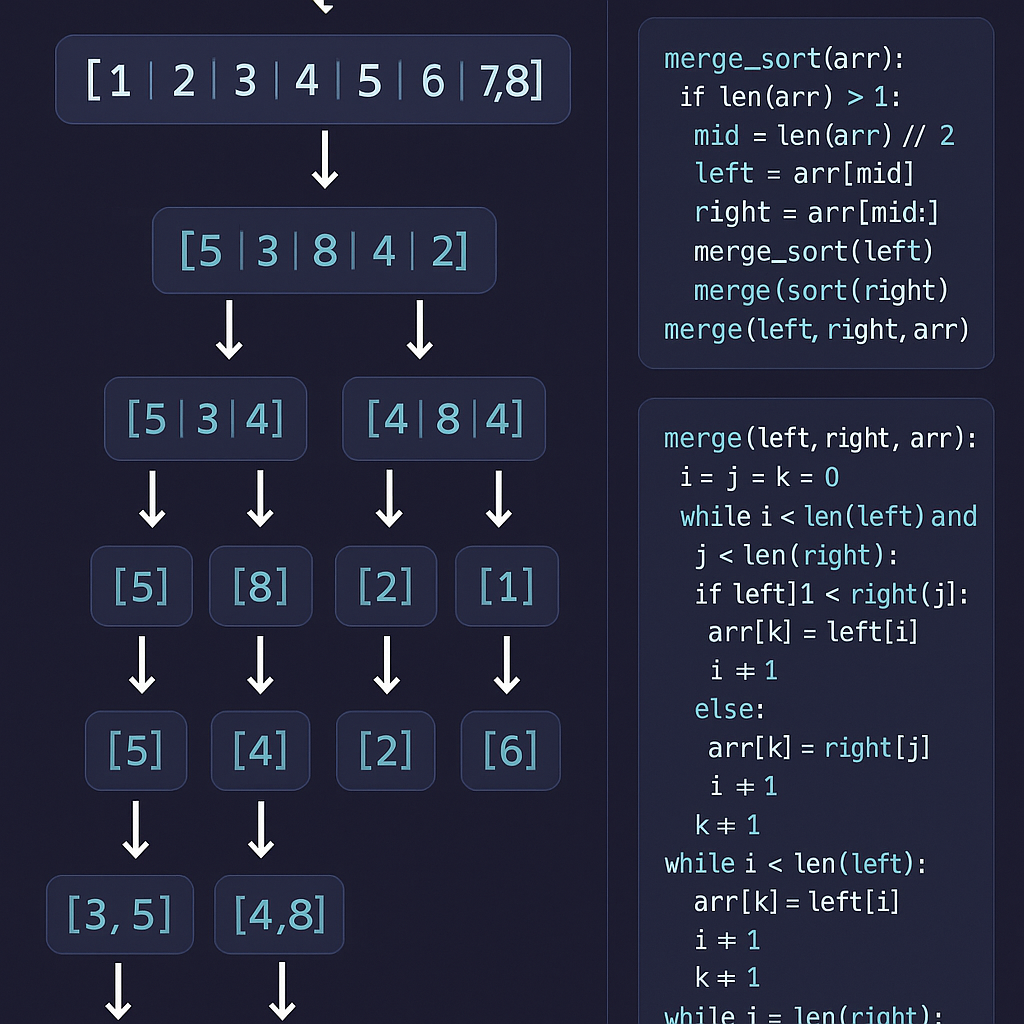
Merge Sort is a classic ‘divide and conquer’ algorithm. The basic idea is to divide the array into halves, recursively sort each half, and then merge the sorted halves to produce a fully sorted array. This approach guarantees a time complexity of O(n log n) in all cases.
Here’s a high-level pseudocode for Merge Sort:
def merge_sort(arr):
    if len(arr) <= 1:
        return arr
    mid = len(arr) // 2
    left = merge_sort(arr[:mid])
    right = merge_sort(arr[mid:])
    return merge(left, right)
The ‘merge’ function combines two sorted lists into a single sorted list, which is what makes Merge Sort so efficient.
2. Implementing Merge Sort in Python
Let’s dive into a real, working implementation of Merge Sort in Python. This code is clear, concise, and well-suited for education or production:
def merge(left, right):
    merged = []
    i = j = 0
    while i < len(left) and j < len(right):
        if left[i] <= right[j]:
            merged.append(left[i])
            i += 1
        else:
            merged.append(right[j])
            j += 1
    # Append remaining elements (if any)
    merged.extend(left[i:])
    merged.extend(right[j:])
    return merged

def merge_sort(arr):
    if len(arr) <= 1:
        return arr
    mid = len(arr) // 2
    left = merge_sort(arr[:mid])
    right = merge_sort(arr[mid:])
    return merge(left, right)

# Example usage
arr = [38, 27, 43, 3, 9, 82, 10]
sorted_arr = merge_sort(arr)
print(sorted_arr)  # Output: [3, 9, 10, 27, 38, 43, 82]
The recursive breakdown and efficient merge combine to create a stable and reliable sorting process. By using pure functions and avoiding side-effects, this code is easy to test and maintain.
3. Real-World Use Cases and Automation Tips
Merge Sort is especially useful for sorting large datasets or lists that do not fit into memory (external sorting). For example, imagine processing log files or large CSV records in an ETL pipeline:
import csv

def sort_large_csv(input_file, output_file, key_col):
    with open(input_file) as f:
        reader = list(csv.DictReader(f))
    sorted_rows = merge_sort(reader, key=lambda r: r[key_col])
    with open(output_file, 'w', newline='') as outf:
        writer = csv.DictWriter(outf, fieldnames=reader[0].keys())
        writer.writeheader()
        writer.writerows(sorted_rows)
# This approach can be parallelized or combined with chunk-wise sorting for massive datasets.
Tip: Merge Sort’s predictable time complexity makes it suitable for real-time systems or applications where worst-case performance truly matters.
4. Optimization Strategies and Pythonic Patterns
One common optimization is to avoid making unnecessary copies of the list at each recursive step, especially if you are working with large arrays. Also, for small subarrays (length < 32 or 64), you may switch over to a simpler algorithm like Insertion Sort, which can be faster due to lower constant factors.
def insertion_sort(arr):
    for i in range(1, len(arr)):
        key = arr[i]
        j = i - 1
        while j >= 0 and arr[j] > key:
            arr[j + 1] = arr[j]
            j -= 1
        arr[j + 1] = key
    return arr

def merge_sort_optimized(arr):
    if len(arr) <= 16:
        return insertion_sort(arr)
    mid = len(arr) // 2
    left = merge_sort_optimized(arr[:mid])
    right = merge_sort_optimized(arr[mid:])
    return merge(left, right)
This hybrid approach is used in Python’s own `Timsort` (the sorting algorithm behind the built-in `sort()` and `sorted()` functions), blending Merge Sort and Insertion Sort’s benefits.
5. Performance Considerations and Best Practices
Merge Sort’s O(n log n) performance is attractive, but it comes at the cost of extra space; merging arrays requires O(n) auxiliary space. For lists of large objects, this can be significant. If space is at a premium, consider in-place algorithms (like Heap Sort or Quick Sort)—but be aware of trade-offs like stability and worst-case time.
- Stability: Merge Sort preserves the order of equal elements (important for multi-key sorts).
- Thread-safety: Pure recursive implementations are easy to parallelize, though Python’s GIL limits CPU-based threads. Use multiprocessing for true concurrency.
- Use Built-Ins: For most applications, prefer Python’s `sorted()` and `.sort()`—they are highly optimized and cover nearly all real-world cases.
Conclusion
Merge Sort is an essential algorithm for every developer’s toolkit. Its theoretical foundations, reliable performance, and real-world applicability make it worth mastering. By understanding its mechanics and optimizations, you gain the skills to choose and adapt the best sorting strategy for your application.
Useful links: