
Unlocking the Power of Python Generators: Deep Dive with Practical Examples
Introduction
Python generators are one of the language’s most powerful features for efficient and clean coding, yet they’re often underutilized or misunderstood. Unlike lists, generators produce items on the fly, enabling you to process massive data streams while keeping memory usage minimal. In this deep dive, we’ll examine how generators work, showcase several real-world examples, and provide performance tips to help you get the most out of them.
1. Understanding Generators: The Concept and Syntax
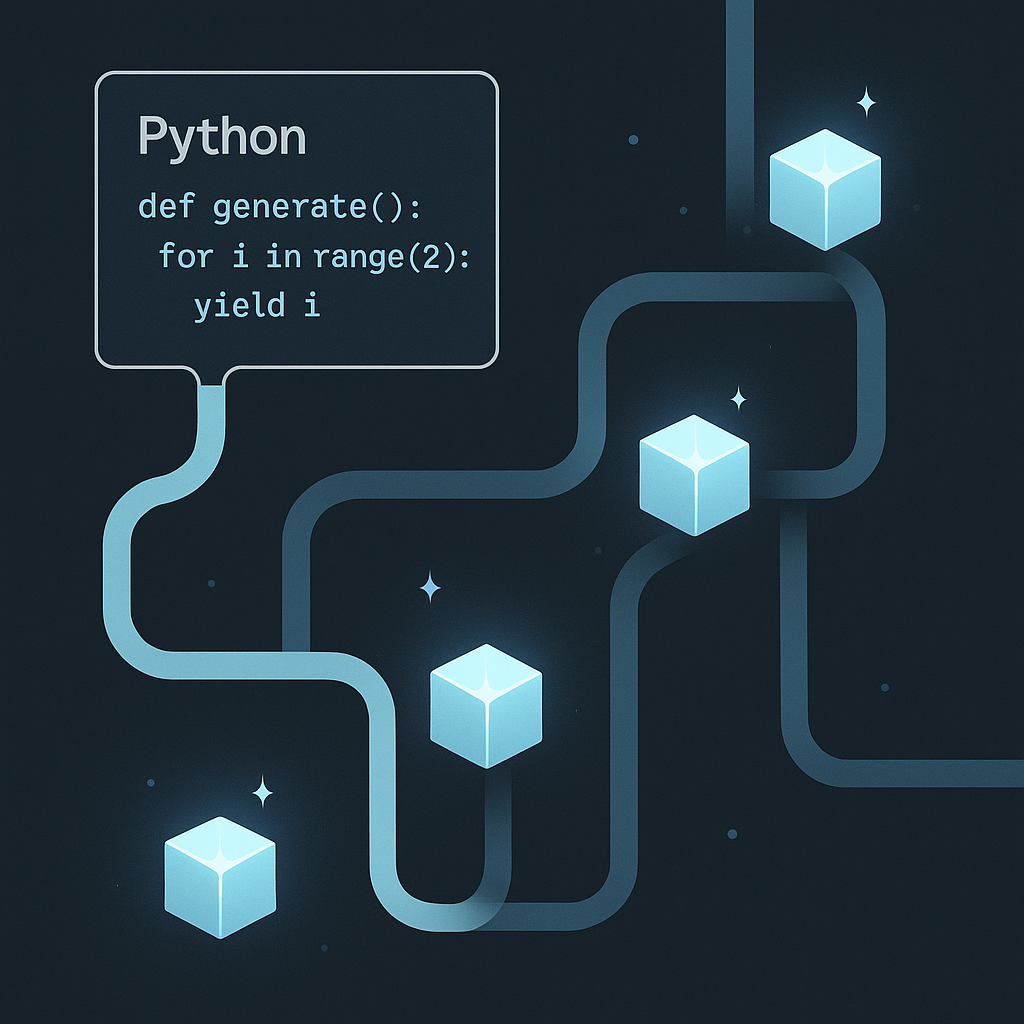
Generators are iterators that yield items one at a time, only when required. They’re defined like regular functions but use the yield statement to return values.
def count_up_to(n):
    count = 1
    while count <= n:
        yield count
        count += 1

for number in count_up_to(5):
    print(number)
# Output: 1 2 3 4 5
How it works: Each time yield is called, execution is paused and state remembered, resuming on the next iteration. Use generators when processing huge datasets to save memory and speed up operations.
2. Real-World Use Case: File Processing
Imagine reading a massive log file. Loading it all into memory isn’t scalable. Let’s use a generator to efficiently process large files line by line:
def read_log_lines(filepath):
    with open(filepath, 'r') as f:
        for line in f:
            yield line.strip()

for line in read_log_lines('system.log'):
    if 'ERROR' in line:
        print(line)
Why this matters: This approach is memory efficient, since only one line is read at any time. It’s great for logs, CSVs, or anything large.
3. Generator Expressions: Concise and Powerful
Python supports generator expressions, similar to list comprehensions but with round brackets:
squared = (x*x for x in range(1000000))
print(next(squared))  # 0
print(next(squared))  # 1
Performance tip: Since values are produced lazily, you can iterate or sum huge sequences without memory spikes:
total = sum(x*x for x in range(1000000))Use generator expressions for filtering, transforming, and aggregating data efficiently.
4. Chaining Generators for ETL Pipelines
Generators are composable. You can build data pipelines by chaining multiple generators:
# Step 1: Read lines
def read_lines(f):
    for line in f:
        yield line
# Step 2: Filter

def filter_errors(lines):
    for line in lines:
        if 'ERROR' in line:
            yield line
# Step 3: Parse

def parse_error(lines):
    for line in lines:
        yield line.split(' ', 2)[-1]  # Extract actual error

with open('system.log') as f:
    lines = read_lines(f)
    errors = filter_errors(lines)
    messages = parse_error(errors)
    for msg in messages:
        print(msg)
This modular setup is clear, testable, and highly memory efficient—ideal for ETL (Extract, Transform, Load) and data ingestion pipelines.
5. Advanced Pattern: Bidirectional Generators with send()
Generators can not only yield values but also receive signals or data. This makes them suitable for coroutines or light-weight state machines:
def stateful_counter():
    count = 0
    while True:
        value = (yield count)
        if value is not None:
            count = value
        else:
            count += 1

counter = stateful_counter()
next(counter)      # Initialize
print(counter.send(None))  # 1
print(counter.send(10))    # set to 10, prints 10
print(counter.send(None))  # 11
When to use: This pattern is less common but excellent for reactive programming or when external updates during iteration are needed.
Conclusion: Getting Practical with Generators
Generators allow for elegant, clean, and efficient code when dealing with large or infinite sequences. Whether building scalable data pipelines, processing files, or adopting more complex coroutine-style flows, generators are a foundational Python tool every developer should master. Remember to always consider trade-offs—generators don’t support indexing or random access, so use them when sequential access is needed.
Resources and Further Reading
- Real Python: Introduction to Python Generators
- Python Docs: Functional Programming HOWTO – Generators
Useful links: