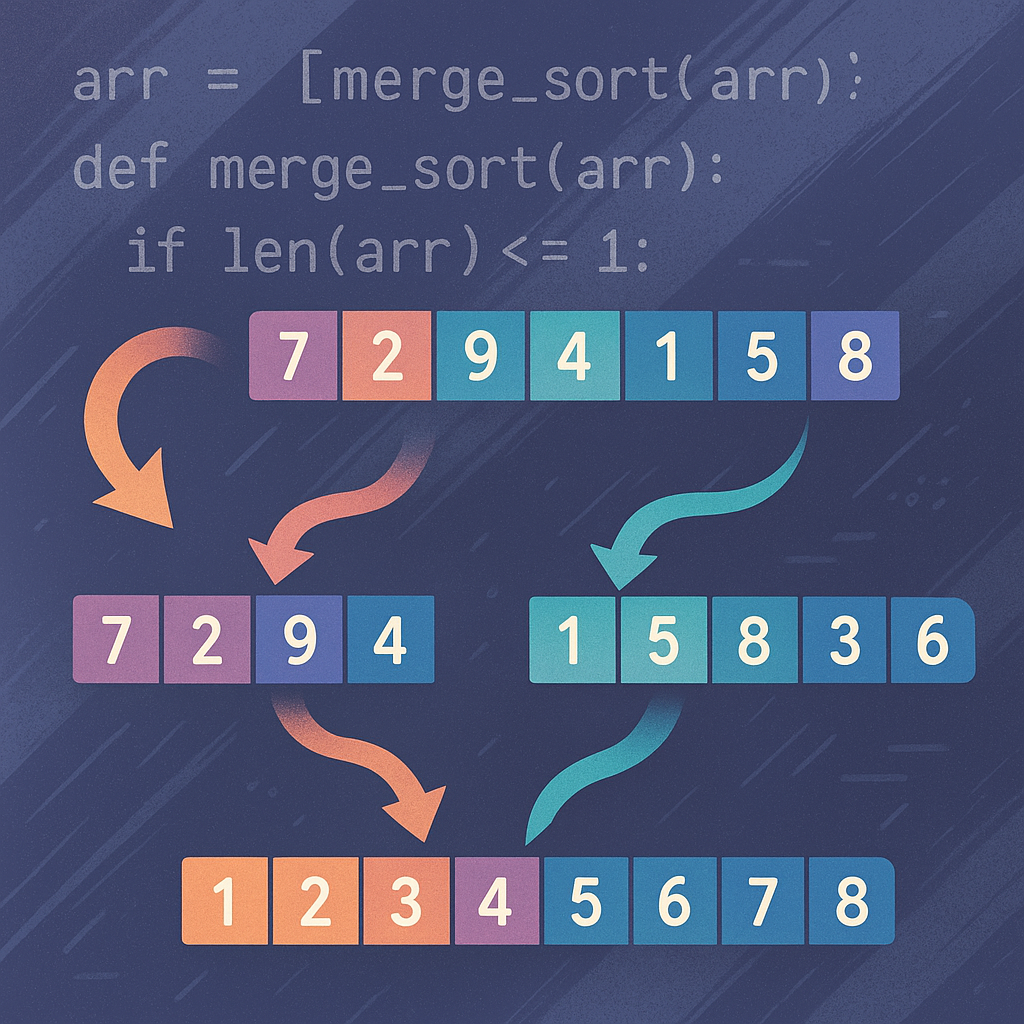

Mastering Merge Sort: A Deep Dive into Efficient Sorting in Python
Sorting is a fundamental operation in computer science, and mastering efficient techniques can greatly improve the performance of your programs. Merge sort stands out as an exemplary divide-and-conquer algorithm with a consistent O(n log n) time complexity for sorting large datasets. In this post, we’ll dive deep into understanding, implementing, and optimizing merge sort in Python, with real-world use-cases and best practices.
1. Understanding Merge Sort: The Divide and Conquer Approach
Merge sort works by recursively splitting an array into smaller subarrays until each is trivially sorted, then merging them together in a way that produces a sorted result. The advantage lies in its consistency—it performs well even on large or nearly-sorted data sets, unlike other algorithms which can degrade under certain conditions.
Visual Process:
- Divide the array in half until you have individual elements
- Merge pairs of arrays, sorting as you merge
- Continue until one fully sorted array remains
Python Concept Overview:
def merge_sort(arr):
    if len(arr) <= 1:
        return arr
    mid = len(arr) // 2
    left = merge_sort(arr[:mid])
    right = merge_sort(arr[mid:])
    return merge(left, right)
This recursive structure forms the backbone of merge sort and is key to its efficiency.
2. Coding Merge Sort from Scratch in Python
Let’s translate our understanding into a practical, working Python implementation. We’ll build both the recursive splitter and the merging logic.
def merge(left, right):
    result = []
    i = j = 0
    while i < len(left) and j < len(right):
        if left[i] <= right[j]:
            result.append(left[i])
            i += 1
        else:
            result.append(right[j])
            j += 1
    # Combine leftovers
    result.extend(left[i:])
    result.extend(right[j:])
    return result

def merge_sort(arr):
    if len(arr) <= 1:
        return arr
    mid = len(arr) // 2
    left = merge_sort(arr[:mid])
    right = merge_sort(arr[mid:])
    return merge(left, right)

# Example usage
arr = [38, 27, 43, 3, 9, 82, 10]
print(merge_sort(arr))
This code produces a fully sorted list. The algorithm remains stable (preserves the order of equal items), which is useful for real-world data like time-stamped logs or grade books.
3. Performance Characteristics and Complexity Analysis
Merge sort’s key performance metrics include:
- Time Complexity: Always O(n log n) due to the halving (log n) and merging (n)
- Space Complexity: O(n), since each merge creates a new result array
- Stability: Stable, so equal elements retain order
Tip: If memory is a limitation, consider in-place variants or other algorithms like TimSort (Python’s built-in sorted() function uses TimSort, which combines the best of merge and insertion sort).
4. Real-World Use Cases for Merge Sort
Where is merge sort especially useful?
- Sorting large files in external storage: When files are too big for RAM, merge sort’s predictable access patterns make it ideal for ‘external sorting.’ Split files, sort chunks, then merge sorted runs—a common pattern in log processing and database engines.
- Parallel sorting: Each sub-array can be sorted independently, making merge sort highly parallelizable. Python’s multiprocessing or threading modules can leverage this.
Example: Parallel Merge Sort with ProcessPoolExecutor
from concurrent.futures import ProcessPoolExecutor

def parallel_merge_sort(arr):
    if len(arr) <= 1:
        return arr
    mid = len(arr) // 2
    with ProcessPoolExecutor() as executor:
        left_future = executor.submit(parallel_merge_sort, arr[:mid])
        right_future = executor.submit(parallel_merge_sort, arr[mid:])
        left = left_future.result()
        right = right_future.result()
    return merge(left, right)
Note: Overhead of process creation means this is most efficient for large arrays; for small data, standard merge sort is faster.
5. Optimizations and Best Practices
Optimization Tips:
- Minimize Copying: Reuse arrays or buffers when possible to reduce memory allocations.
- Switch to Insertion Sort for Small Arrays: For arrays of size 16 or less, insertion sort can be faster. Python’s TimSort uses this optimization.
Hybrid Example:
def insertion_sort(arr):
    for i in range(1, len(arr)):
        key = arr[i]
        j = i - 1
        while j >= 0 and arr[j] > key:
            arr[j + 1] = arr[j]
            j -= 1
        arr[j + 1] = key
    return arr

def optimized_merge_sort(arr):
    if len(arr) <= 16:
        return insertion_sort(arr)
    mid = len(arr) // 2
    left = optimized_merge_sort(arr[:mid])
    right = optimized_merge_sort(arr[mid:])
    return merge(left, right)
Profiling and benchmarking are crucial when making optimization decisions—experiment with array sizes and data types relevant to your application.
Conclusion
Merge sort remains a workhorse sorting algorithm due to its predictable complexity and usefulness in large-scale and parallel processing scenarios. By understanding its mechanics and potential optimizations, you can confidently solve a wide range of sorting problems efficiently in Python.
Useful links: